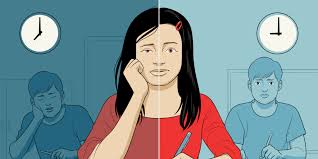
About 40% of high schools in the United States currently have a start time before 8:00 in the morning. Only 15% start at 8:30 or later.” (Later School Start Times..). My school, Leyden high school starts at 7:35 a.m. From the time that I fall asleep to the time I wake up it is dark outside, silent in my house. The only time I ever get enough sleep is on the weekend. I have sports that keep me at school till 5 and even at times around 9, leaving me to not have time for my homework and get a good night’s sleep.
8 hours of sleep is the minimum. That should be easy right? Well not so much for high school students. Research has shown that“…only one-quarter of high school age adolescents reported sleeping the minimum recommended eight hours each night” (Urton). This is out of millions of kids. School start time as well as school work is having a big effect on their sleep. School makes it hard for students to be able to get the sleep that their bodies need. Students try to sleep in, “But even sleeping until noon on weekends isn’t enough to make up for the sleep deficit they accumulate night after night during the school week.” (Weir) Students wake up around 6 in the morning just to be ready for school. They drag themselves out of bed and walk into school with sleep still in their eyes. This is making them sleep deprived. Their bodies beg to go back to sleep but they go to school instead. Yet are students expected to do well on tests when they haven’t even gotten a good night’s sleep since the school year started. “‘To ask a teen to be up and alert at 7:30 a.m. is like asking an adult to be active and alert at 5:30 a.m..’” (Urton). So not only does the start time affect kids’ sleep schedules it also affects their grades since it’s too early for them to be able to effectively focus. If schools started later, then students would be able to focus during their first periods and not only the ones that are later on in the morning. Grades could improve and students could feel proud of themselves.
As students get older they start to go to “…undergo a shift in their circadian clocks. That shift makes it hard for teens to fall asleep until later in the night.”(Weir). Yet schools don’t accommodate for that. Not only do teens get tired later, some also have after school sports or activities that cause them to get home at later times. I do different sports at my school and I can’t start my homework until around 7 on days where I just have practice. It then takes me 2-3 hours just to do my homework. Getting home later causes students to not have as much time for themselves, time to rest after a long day. Yet schools don’t allow students the appropriate amount of rest and expect them to learn and obtain new information, new equations, think about different problems around the world, run laps around the gym, or even write an essay all while the student is running off of coffee or energy drinks. I personally never drank so many energy drinks until sophomore year. Yet I feel like I need some sort of form of caffeine every morning now just so I can try to understand what my geometry and chemistry teacher are telling me at 7-9 in the morning. I have to try to remember new vocab and not allow myself to zone out because of how tired I am. I myself can’t fall asleep until around 10:30 but I have to wake up at 5:30 so that I can be ready on time because in the morning it takes me so long to get ready since I am so tired.
Not only does school time affect our sleep schedules, it also affects mental health. As we all should know, sleep and mental health are tied closely together. Without getting the right amount of sleep night after night students can start to “Adolescent health is significantly improved by having later start times,” Wahlstrom said, with reductions in substance use, suicidal, and depression.”’ (Wheaton). Do schools want to be the reason that they are losing their students? Do they want to be the reason mothers and fathers are losing their children? School start time won’t just let us sleep, it will save lives. This also doesn’t just affect mental health. Studies have shown that “disrupted circadian rhythms can adversely affect digestion, heart rate, body temperature, immune system function, attention span..”(Urton). With weaker immune systems kids get sick more often and have to skip school, which risks falling behind, or have to sit through class while they can barely see straight.
Raising the 15% would allow more students to be able to enjoy school and not have to dread waking up so early in the morning. Students would have the sleep they need to increase their grades and focus in their classes. Not only that, they can enjoy their sports without focusing on the homework that they have to get done before they can go to sleep. They won’t feel the need to drink coffee or energy drinks just so that they can stay awake while listening to a complicated lesson at 7:30 in the morning. Mental health in teens wouldn’t be so bad and students wouldn’t have to wake up around 5 or 6 in the morning to get to school on time. Overall a later school start time would greatly benefit students and would likely help them improve their grades, health, and sleep schedules.
Works Cited
“Later School Start Times: Lazy or Legit?” University of Utah Health | University of Utah Health, 16 Mar. 2015, healthcare.utah.edu/the-scope/kids-zone/all/2024/09/later-school-start-times-lazy-or-legit.
Urton, James. “Teens Get More Sleep, Show Improved Grades and Attendance with Later School Start Time, Researchers Find.” UW News, University of Washington, 12 Dec. 2018, www.washington.edu/news/2018/12/12/high-school-start-times-study/.
Weir, Kirsten. “Schools Shift as Evidence Mounts That Later Start Times Improve Teens’ Learning and Well-Being.” American Psychological Association, 30 Oct. 2023, www.apa.org/topics/children/school-start-times.
Wheaton, Anne G., et al. “School Start Times, Sleep, Behavioral, Health, and Academic Outcomes: A Review of the Literature.” Journal of School Health, vol. 86, no. 5, 3 Apr. 2016, pp. 363–381. National Library of Medicine, www.ncbi.nlm.nih.gov/pmc/articles/PMC4824552/, https://doi.org/10.1111/josh.12388.
Proquest.com, 2026, explore.proquest.com/sirsissuesresearcher/document/3309272745?searchid=1776107134&accountid=63828. Accessed 13 Apr. 2026.