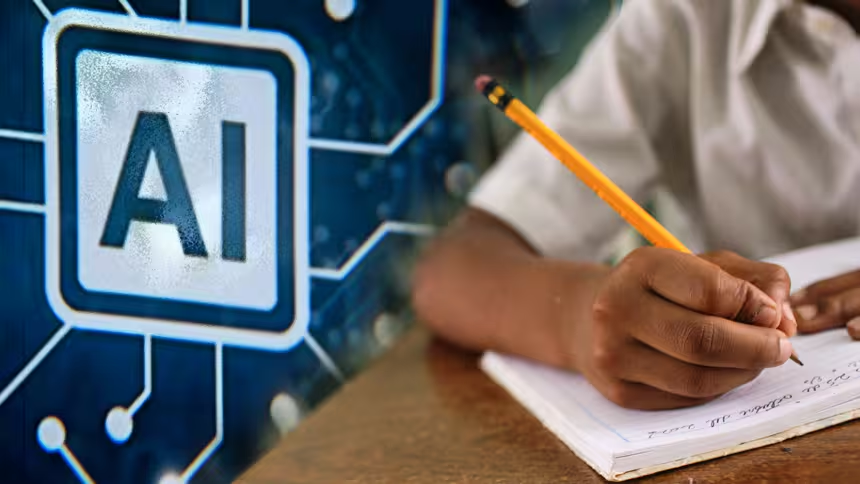
When you’d bring up the future to people, the first couple things that come to mind would be flying cars, going to mars, etc. It would be a scenario out of Blade Runner 2049. Yet now that we’ve gotten to the future, it’s not what we first imagined. Artificial intelligence is the newest and most revolutionary item to come up. In reality it’s been around more than we think. AI has infiltrated schools, relationships, and our minds. And many are wondering where will AI lead next, it’s already taken over the school system. So people should know the truth about it.
AI has damaged education in ways too many to count. One of the ways is students use AI to create their own ideas ruining the creative and mental process of learning. An article from College Board which connects colleges and students through the SAT and sets up the AP curriculum states “Half of high school students are using AI tools for schoolwork to brainstorm ideas, edit or revise essays, and/or conduct research and find sources.”(Collegeboard). The use of Ai is an increasing matter, it does in fact help students organize papers or revise their essay. All though, the usage gets to a point where it creates a dependency on it. Students always running to Ai to make their own ideas for them ruins the students mind by destroying the students creativity and critical thinking. A student not using their own mind to generate ideas slows down the actual point of an education because as you go through the school system each difficult problem you face is an exercise for your mind, growing the neuron connections in the brain. The process is called long-term potentiation. It is quite literally the process of strengthening the connections between neurons (brain cells) based on recent activity and constant stimulus. It is the basis of learning and memory. This process slowed down by Artificial Intelligence leads to impairments in learning and forming new long-term memories. This affects a student’s education not just in the writing process or solving difficult equations. It affects students’ ability to learn new information, in every new unit in a student’s schedule: history class, physics, economics, AP bio. Whatever the class, it hurts the process of long-term retention because once it is difficult to form new memories you begin to fail in your studies. This can lead to a sense of confusion, inferiority, and deep overwhelming sadness. Once that cycle starts it’s hard to get out of it. I can understand the confusion that comes with not being able to memorize the concepts needed for a big test and once that test score comes back and it’s not what you wanted it makes you blame yourself. “Why couldn’t I just remember?” “Why did this go this way?” “What went wrong?” This can send young teens down a spiral they never wanted to be in.
Artificial Intelligence is a big part of some students’ daily work and we’ve seen the effect it has on students, yet the educators aren’t innocent either. It has also creeped into their hands. University of Illinois Urbana-Champaign writes on the pros and cons of Artificial Intelligence in schools. “ It can streamline administrative tasks, free more time for teachers to build relationships and the social and emotional skills of students, tailor students’ learning experiences according to their individual needs and learning styles, and improve accessibility for students with disabilities.” Each and everyone of these reasons are true and hold up well but it is the teachers, administrators, and all adults in the building to do their tasks as educators. There shouldn’t be a shortcut to accommodating students or building relationships with them. Those things should be worked through and they shouldn’t be a quick process. It is understandable that a teacher is busy. They have a multitude of students but it is in their job to do everything in their power to help the ones they build up from nothing. Micheal Healy, a superintendent says “Teachers are now using tools like chatbots and writing assistants, while principals and superintendents are developing policies to guide safe and appropriate use.”(Healy). This is the biggest example of an oxymoron. How could a teacher who promotes policy to stop the usage of Artificial Intelligence also be the one to use it in making their lesson plans and worksheets that they give their students? It makes the teacher untrustworthy, if you’re a student in any class getting a lecture from your teacher on how using AI on this new assignment they’re giving you is pointless but the teacher also just used Chat gpt to format your latest quiz. It starts to create questions of the legitimacy of your educators.
Students may feel that Artificial intelligence was created and computerized in their best interest. But was it? The University of Illinois Urbana-Champaign brings out the potential bias that AI has “Part of the problem is that GPT detectors are programmed to recognize language that is more literary and complex as more “human.” Thus, writers not using such language are more likely to be categorized as using AI-generated content and could be unjustly flagged for AI plagiarism. Non-English-speaking students may be falsely accused of cheating, which can undermine their academic career and damage their psyches.” About 54% of students use AI for help with school work (Atske). If the other half of students who don’t use AI but their first language just isn’t English their work is flagged for plagiarism and the other students who do write in a “literary” fashion of just knowing English have it easier. And if those students whose papers were actually written by Chat gpt would be able to get away with it. It belittles the other student who just didn’t have the same life as others. AI was computerized not with every person in mind but just with the biggest demographic that the owners of AI could get to use their website. The point of AI is just like any other website to get clicks, the more clicks that website gets the more money the “CEO” gets.
The most disheartening thing for a student is to not be believed that you didn’t plagiarize your essay just because your writing didn’t fit the standard. Which is what will keep occurring if Ai continues to have this bias. Chat gpt sure can help students get through hard topics in classes but there is a recurring pattern of it creating fake sources. Aaron Welborn, a writer at Duke University in an article on Chat gpt’s fake sources states, “One such limitation is that it has been known to fabricate or “hallucinate” (in machine learning terms) citations. These citations may sound legitimate and scholarly, but they are not real” This is just showing that Ai will always take a short cut to produce quicker results and once a person is actually trying to find said sources and lead to a dead end. In reality it makes the person who used the fake source look stupid. You’re telling me you just couldn’t look at a website, article, blog, whatever it is and sit down and read it to find what you’re looking for. It doesn’t even take that long to read something but the quick speed of AI has made us used to things coming easy to us. There were times where people would have to scavenge through books to find articles but now the entrance to knowledge lies at your fingertips. So easy to grab yet not as easy for a person who needs a dopamine hit every second.
As we conclude, the creation of AI is relatively a mystery to most of us but we all know and see the effects of it in real time. Some might say that AI has only created a more helpful world by giving quicker access to information, helping people out with school work, etc. However, like the points I’ve said before, it’s unreliable, the increase of Artificial Intelligence is just billionaire CEOs getting on to a bandwagon. Chat gpt, Open AI, grok, wasn’t created for people but to create a money pit for the people already so rich their income is nowhere near a working class citizen. And not to mention the immense impact AI’ data centers have on the environment. So the question is should this monster of a machine be a policy decision in our democracy today?
Works Cited
Shors, Tracey J., and Louis D. Matzel. “Long-Term Potentiation: What’s Learning Got to Do with It?” Behavioral and Brain Sciences, vol. 20, no. 4, Dec. 1997, pp. 597–614, https://doi.org/10.1017/s0140525x97001593.
“New Research: Majority of High School Students Use Generative AI for Schoolwork.” Collegeboard.org, 2025, newsroom.collegeboard.org/new-research-majority-high-school-students-use-generative-ai-schoolwork.
Healey, Michael. “The Pros and Cons of AI in Education: Benefits, Risks, and Real Examples | Discovery Education Blog.” Discovery Education, 9 Dec. 2025, www.discoveryeducation.com/blog/educational-leadership/ai-in-education/.
University of Illinois. “AI in Schools: Pros and Cons.” College of Education, College of Education at Illinois, 24 Oct. 2024, education.illinois.edu/about/news-events/news/article/2024/10/24/ai-in-schools–pros-and-cons.
Atske, Sara. “How Teens Use and View AI.” Pew Research Center, 24 Feb. 2026, www.pewresearch.org/internet/2026/02/24/how-teens-use-and-view-ai/ .
Welborn, Aaron. “ChatGPT and Fake Citations.” Duke University Libraries Blogs, 9 Mar. 2023, blogs.library.duke.edu/blog/2023/03/09/chatgpt-and-fake-citations/.